Measure the same place
Do not compare a wall reading near the upper bench with a heater sensor near the ceiling. Consistent position creates consistent context.
Two readings, one calmer ritual
A sauna is not defined by temperature alone. Heat and moisture continually shape how the room feels, how quickly the climate changes, and how repeatable each session becomes. A combined analog instrument lets you read both conditions at a glance.
Sauna climate fundamentals
Temperature is the most familiar sauna measurement, but it is only half of the immediate experience. The same numerical temperature can feel restrained in dry air and sharply intense after water is poured over hot stones. Moisture influences how efficiently heat reaches the skin and how the air feels when you breathe. A sauna thermometer hygrometer makes that relationship visible by placing a temperature scale and a relative humidity scale side by side.
The value is not that the instrument chooses a perfect climate for you. There is no universal pair of numbers that suits every sauna type, every bench position, and every person. Its real value is repeatability. Once you know which readings correspond with a comfortable session in your own room, the dials become a simple reference. You can recognize when the cabin has reached your preferred condition, observe the effect of ventilation, and see how quickly the humidity settles after a burst of steam.
This combined instrument appears under several product names. A shopper may search for a thermometer, a hygrometer, or a gauge, even though the desired function is the same. RUVARO currently combines all four descriptions in one cedar 2-in-1 product. Each term below therefore opens the same live Amazon listing for model RC-001.
Open the current RUVARO 2-in-1 cedar product listing on Amazon.
02Open the current RUVARO 2-in-1 cedar product listing on Amazon.
03Open the current RUVARO 2-in-1 cedar product listing on Amazon.
04Open the current RUVARO 2-in-1 cedar product listing on Amazon.
Hot air rises, so a sauna normally develops vertical temperature layers. The ceiling zone can be considerably hotter than the lower bench and floor. A thermometer mounted high on the wall may therefore show a higher value than the air around your torso. Move the same instrument lower, and the reading changes even though the heater setting has not. This is why comparing numbers from two different cabins only makes sense when the measurement positions are reasonably similar.
Doors, fresh-air inlets, exhaust openings, large glass surfaces, and the heater itself create additional local effects. A gauge beside the door can be influenced by each opening. A gauge close to the heater may react to radiant heat or an unusually hot air stream. The most useful location is usually a representative wall area near the zone occupied by a seated bather, not the hottest possible point in the cabin.
A hygrometer shows relative humidity, commonly abbreviated as RH. The word relative matters. Warm air can contain more water vapor than cool air. If the amount of moisture remains roughly the same while the sauna heats, the displayed RH can fall because the warmer air is farther from saturation. The cabin can therefore become hotter and feel dry while the percentage decreases.
When water reaches heated stones, part of it rapidly becomes vapor. The hygrometer may then climb, sometimes with a short delay, before returning toward its earlier level as ventilation removes moisture and surfaces absorb or release heat. That temporary change is one of the main reasons a humidity dial adds context that a thermometer alone cannot provide. It helps distinguish a stable dry phase from a short, more intense steam phase.
Read patterns, not isolated numbers. An analog dial is most informative when you watch how it moves during warm-up, after the door opens, and after water is added. Your own repeated observations are usually more useful than chasing one supposedly ideal percentage.
Reading the instrument
A combined gauge is intentionally uncomplicated. The thermometer responds to the surrounding air temperature. The hygrometer responds to changes in relative humidity. The needles do not need to move at the same speed, and a fast climate change can occur before either mechanism has fully settled.
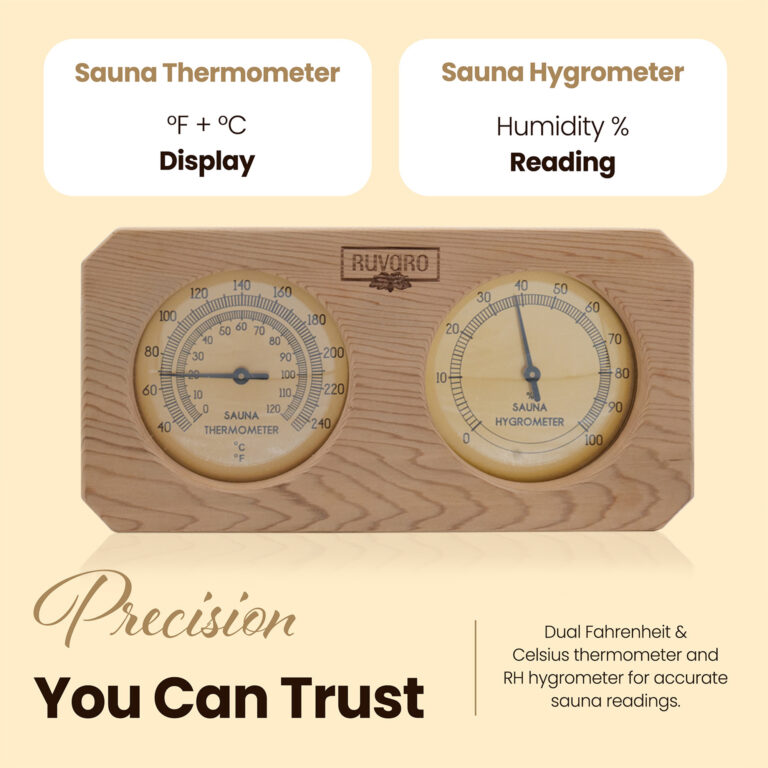
The RUVARO thermometer uses Fahrenheit on the outer arc and Celsius on the inner arc. Its second dial displays RH as a percentage. This arrangement is useful in an international household because the temperature does not need to be converted mentally before each session.
Placement before precision
A perfectly calibrated instrument in a poor location can be less useful than a modest instrument in a representative location. The wall position determines which pocket of air the gauge describes. Before drilling or using the supplied mounting screw, think about the bench, heater, door, ventilation, and the line of sight from where you normally sit.
A practical starting point is a wall near seated head or upper-body height, where the instrument is easy to see but not directly above the heater. Keep it away from the door opening, supply air, exhaust grille, and the direct path of steam. These locations can create readings that change more sharply than the climate around the bather.
Cabin dimensions and bench levels vary. A fixed distance from the ceiling that works in one sauna may place the gauge too high or too low in another. Follow the sauna and heater manuals first, then use the first few sessions to check whether the reading corresponds with the conditions you actually experience. A small relocation can be more valuable than repeated calibration.
An instrument only helps when it can be read without leaning toward the heater or stepping onto a bench. Leave enough space to access the adjustment points if recalibration is needed. Mount it securely, but avoid overtightening into wood that expands and contracts with changing temperature and moisture.
A better way to interpret the needles
The dials are not laboratory controls. They are practical reference instruments. Their usefulness grows when the position remains consistent, the mechanisms have time to respond, and you compare sessions under similar conditions.
Do not compare a wall reading near the upper bench with a heater sensor near the ceiling. Consistent position creates consistent context.
Mechanical instruments contain physical elements that need time to react. A quick door opening or steam pulse may be felt before the needle reaches its highest or lowest point.
Notice the readings at your preferred start, after the first steam, and near the end. A personal baseline makes future sessions easier to reproduce.
Calibration and care
Analog instruments are appealing because they are self-contained, quiet, and battery-free. Their mechanical simplicity does not mean they should be ignored after installation. Transport, vibration, repeated heat cycles, and normal aging can shift a needle. Calibration is the process of comparing the display with a known reference and making a small correction when the difference is persistent.
Do not judge a new instrument immediately after unpacking it from a cold delivery box or carrying it into a hot room. Allow the wood and mechanisms to reach a stable room condition. After installation, observe several complete sauna cycles before deciding that an adjustment is necessary. A one-time difference during rapid warm-up may reflect response time rather than a permanent offset.
When checking temperature, place a suitable reference instrument close to the sauna gauge so both are exposed to approximately the same air. Comparing devices at different heights can create a false calibration problem because the temperature gradient is real. For humidity, use a recognized reference method or a reliable calibrated meter and follow its instructions. Keep direct water away from the wood and dial assembly.
Use the manufacturer-supplied adjustment tool and guide. Make very small corrections, then allow the mechanism to settle before checking again. Large turns can overshoot the target. The goal is not to force a needle to match every transient change. It is to correct a repeatable offset under stable conditions.
Dust the surface with a soft dry cloth. If necessary, use a barely damp cloth on the external wood and dry it promptly. Do not immerse the instrument, spray cleaner into the dial openings, or use aggressive chemicals that can stain the cedar or leave odors in a heated room. Allow the sauna to ventilate and dry after use, and periodically check that the mounting remains secure.
| Observation | Likely explanation | Useful response |
|---|---|---|
| Temperature differs from the heater control | The sensors are in different positions and may respond at different speeds. | Use each reading for its own purpose and compare only after the cabin stabilizes. |
| Humidity jumps after water is poured | Water vapor briefly increases RH before ventilation and surfaces moderate the change. | Observe the peak and recovery pattern rather than treating the peak as permanent. |
| Needle moves more slowly than the sensation | Your skin responds quickly while the analog mechanism has physical response time. | Wait before recalibrating. A delayed response is not automatically an accuracy fault. |
| Reading changes when the door opens | Cooler replacement air reaches the gauge or alters local circulation. | Consider whether the gauge is too close to the doorway or an air inlet. |
Selection criteria
The best sauna thermometer hygrometer is not necessarily the one with the most markings or the most technical appearance. It should be suitable for the heat and moisture of a sauna, readable from the bench, easy to mount, and consistent enough to become a familiar reference over time.
A normal indoor weather station may contain electronics, batteries, adhesives, or plastics that were not designed for repeated high-temperature exposure. Choose an instrument explicitly sold for sauna use. Heat-resistant dial protection, a stable frame, and materials that tolerate moisture are more relevant than app connectivity inside the cabin.
Fine scales look precise in a product photograph but may be difficult to read through soft sauna lighting or from the opposite bench. High contrast, clear needles, and sufficiently large dials are practical advantages. A dual Fahrenheit and Celsius scale is useful when guests or household members use different systems.
An adjustable analog instrument can be corrected if a stable offset appears. Check whether the adjustment points are accessible and whether instructions and a suitable tool are included. Calibration should be a controlled correction, not a frequent ritual after every steam cycle.
Sauna interiors are visually quiet. A compact wooden frame can blend with wall cladding and benches instead of introducing a bright electronic screen. Cedar offers warm grain and a natural appearance, though each piece of wood varies. That variation is part of the material rather than a defect in uniformity.
A battery-free gauge is always ready to read. There is no charging, pairing, display timeout, or battery chemistry inside the hot room. Digital sensors can offer logging and remote alerts, but an analog unit remains compelling when the goal is immediate, glanceable information during the session itself.
Think of the instrument as a dashboard, not an autopilot. It shows what is happening at its location. You still control the heater, ventilation, water, session length, and your response to the heat.
From principle to product
Once the fundamentals are clear, the product question becomes simpler: can one instrument make those readings easy, durable, and visually calm?
This is where the current RUVARO RC-001 moves from a decorative sauna accessory to a practical interpretation of the requirements above.
The RUVARO interpretation
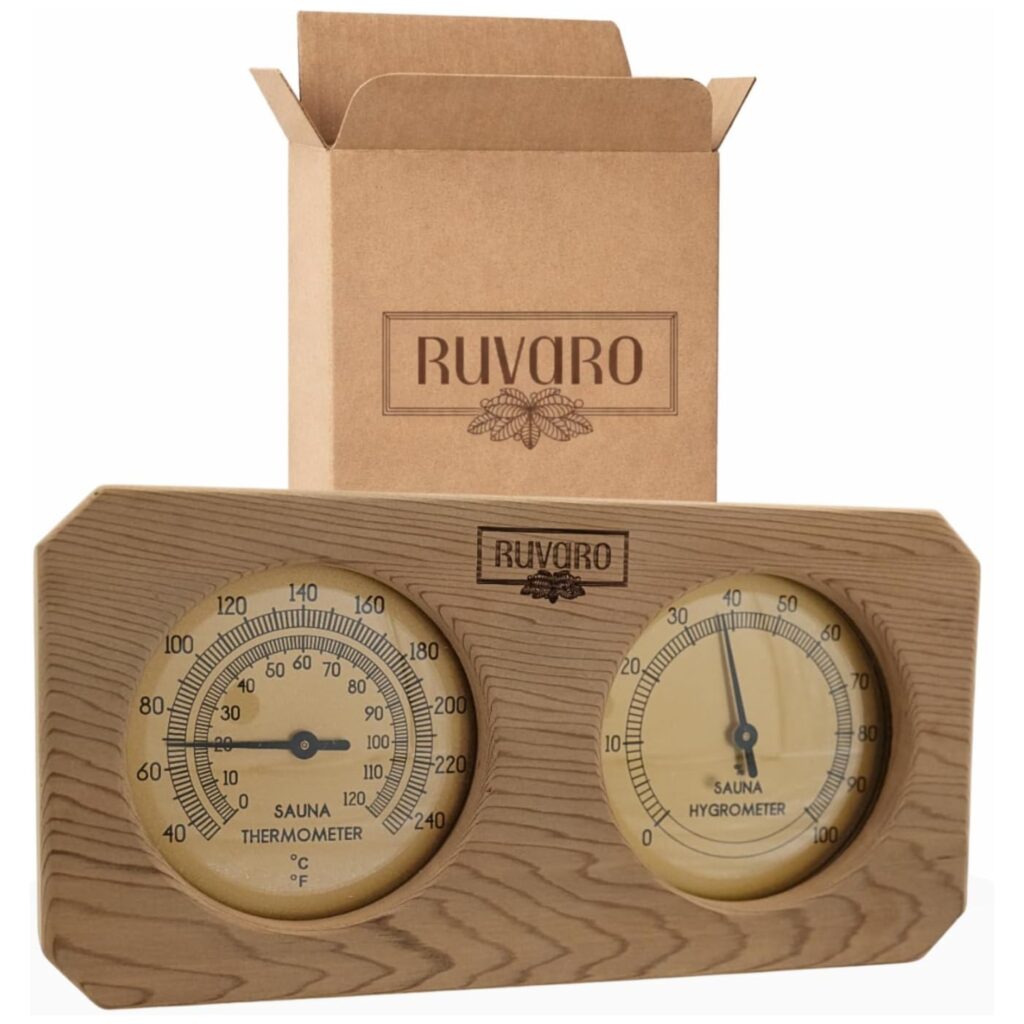
RUVARO places two round gold-accented instruments in a single horizontal frame made from Canadian red cedar. The result is immediately readable without looking clinical. The wood grain visually connects the gauge with cedar, hemlock, spruce, or other warm-toned sauna cladding, while the separate dials keep temperature and humidity distinct.
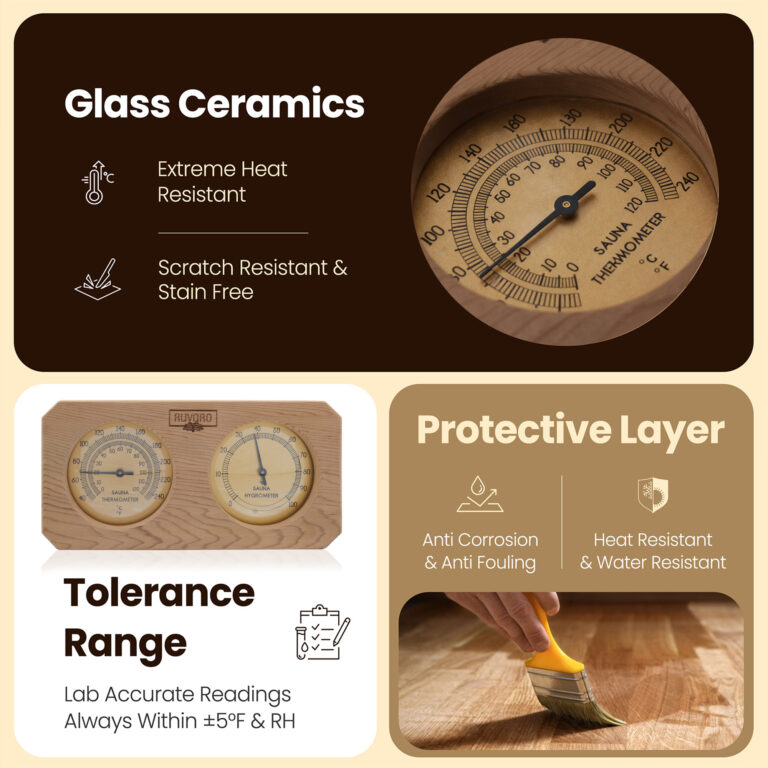
The design is fully analog and does not need batteries. The thermometer presents Fahrenheit on the outer circle and Celsius on the inner circle. Beside it, the hygrometer presents relative humidity. Clear, heat-resistant glass protects the dial faces while keeping the scales visible through the changing light and moisture of a sauna session.
Verified product details
The details below reflect the current official RUVARO page and Amazon.com listing for ASIN B0G7CXJW1P. Product listings can change, so the live listing remains the final reference before purchase.
Open current listingSources: official RUVARO thermometer page and current Amazon.com product listing.
Material, scale, proportion
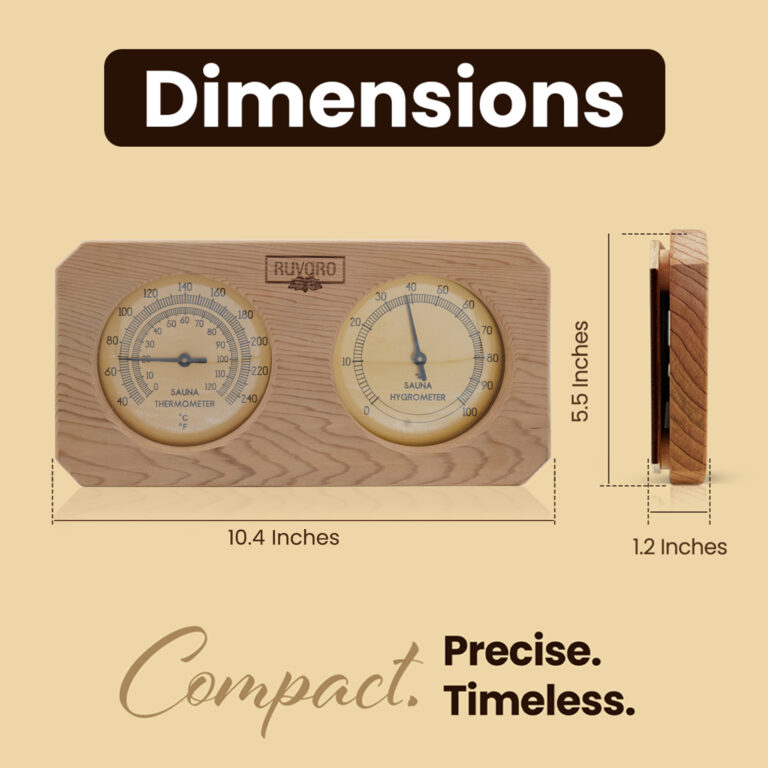
At just over ten inches wide, the RUVARO gauge has enough visual presence for two separate dials while remaining compact on a sauna wall. The horizontal cedar frame follows the lines of common wall paneling and benches.
Included for setup and upkeep
The current Amazon description lists the core instrument plus the small parts needed for mounting and manual calibration. That reduces the need to improvise with an unsuitable tool against a delicate adjustment point.
Practical ownership
The strongest benefit is not a single specification. It is the combination of functions that removes small points of friction. One wall position, one visual style, and one glance provide the two readings most people want during a traditional sauna session. No screen wakes up, no cable crosses the room, and no battery needs attention.
The cedar frame also makes the instrument feel integrated rather than added later. Natural grain gives every piece slight visual variation, while the gold-toned dial faces create enough contrast to read without turning the gauge into a bright technical panel. In a modern pale-wood cabin, the warmer cedar becomes a modest focal point. In a darker traditional room, it feels familiar.
Manual calibration matters because it gives the product a path to remain useful. If comparison under stable conditions reveals a repeatable offset, the owner can correct it rather than discarding the instrument. The included screwdriver and guide make that feature more practical than an adjustment point that exists only in theory.
For a home owner, rental host, spa room, or sauna enthusiast who values a quiet analog interior, that balance is persuasive. The RUVARO does not attempt to log data or automate the heater. It does the more immediate job: showing heat and moisture together in a clear, sauna-suitable form.
Frequently asked questions
Clear answers about measurement, placement, calibration, and the current RUVARO cedar combination gauge.
It combines two mechanical measurements. The thermometer indicates air temperature at the instrument location. The hygrometer indicates relative humidity, or RH, at that same location. Together they give more context than either reading alone.
Humidity, air movement, bench position, warm-up time, and the temperature of surrounding surfaces all affect the sensation of heat. A brief rise in humidity after water reaches the stones can make the air feel much more intense even if the temperature dial barely moves.
Choose a representative wall position near seated upper-body height, where the dials remain easy to read. Avoid direct proximity to the heater, door, fresh-air inlet, exhaust vent, and direct steam path. Always follow the instructions for your sauna and heater because cabin layouts differ.
Not necessarily. The heater sensor and wall gauge may be at different heights and respond at different speeds. A stable difference can be normal when the measurement locations differ. Compare instruments only when they are close together and the room condition is stable.
No. It is a fully analog thermometer and hygrometer. It works without batteries, wiring, an app, or a network connection.
The current product information states that the instruments are adjustable and can be recalibrated. A screwdriver and an installation and calibration guide are included. Make small corrections only after confirming a repeatable offset under stable conditions.
The outer temperature scale is Fahrenheit and the inner scale is Celsius. The separate hygrometer dial shows relative humidity.
Amazon currently lists 10.44 × 5.52 × 1.15 inches and a weight of 10.9 ounces. That is approximately 26.5 × 14.0 × 2.9 cm and 309 grams.
RUVARO markets the mounting setup for sauna use generally. In an infrared cabin, temperature distribution differs from a traditional heater sauna, and humidity usually changes less dramatically. Place the gauge where it represents the seated zone and follow the cabin manufacturer's guidance.
Use a soft dry cloth for routine dusting. If necessary, wipe the exterior wood lightly with a barely damp cloth and dry it promptly. Do not immerse it, spray fluid into the mechanisms, or use strong cleaners that can stain the wood or leave odors.
A more readable sauna ritual
The RUVARO RC-001 combines two adjustable analog instruments, clear heat-resistant glass, and a Canadian red cedar frame in one compact accessory. Check the live Amazon listing for current availability and purchase details.